- A Cloudflare outage earlier today knocked many websites and apps offline, leaving users around the world unable to access services or facing slow, unstable connections.
- The incident served as a reminder of how dependent the internet is on a few major infrastructure companies, showing how one technical issue can disrupt thousands of platforms at once.
- Cloudflare later confirmed and resolved the problem, and services gradually returned to normal after its engineering teams implemented the necessary fixes.
Earlier today, many people were left confused as websites across the internet stopped loading or behaved unpredictably. The issue wasn’t on the user’s end, a major Cloudflare outage had disrupted online services globally. Several popular apps and websites had become slow, unresponsive, or temporarily inaccessible due to the incident.
Why Cloudflare’s outage had such a huge impact
Cloudflare, one of the internet’s most widely used infrastructure providers, played a central role in the disruption. Companies around the world relied on Cloudflare for faster loading speeds, protection against cyber threats, and the ability to handle large traffic volumes. Acting as a bridge between users and websites, Cloudflare cached site data on servers across different regions, which helped reduce load times and shield websites from DDoS attacks.
Because of this broad dependency, the moment Cloudflare faced a problem, many services felt the effects immediately. Even major platforms like ChatGPT and X (formerly Twitter) had become difficult to access during the outage.
A clear example of internet centralization
The incident also highlighted how much of the internet depended on only a few major companies. A single failure had quickly spread across thousands of websites, creating a ripple effect throughout the digital ecosystem.
This wasn’t the first time such a situation occurred. A similar disruption had happened in the past during an AWS (Amazon Web Services) outage, which affected a wide range of apps and online tools. Today’s Cloudflare outage followed a similar pattern—showing how a single technical issue, whether a bug or a networking error, could temporarily affect the functioning of the internet globally.
Cloudflare’s response and resolution
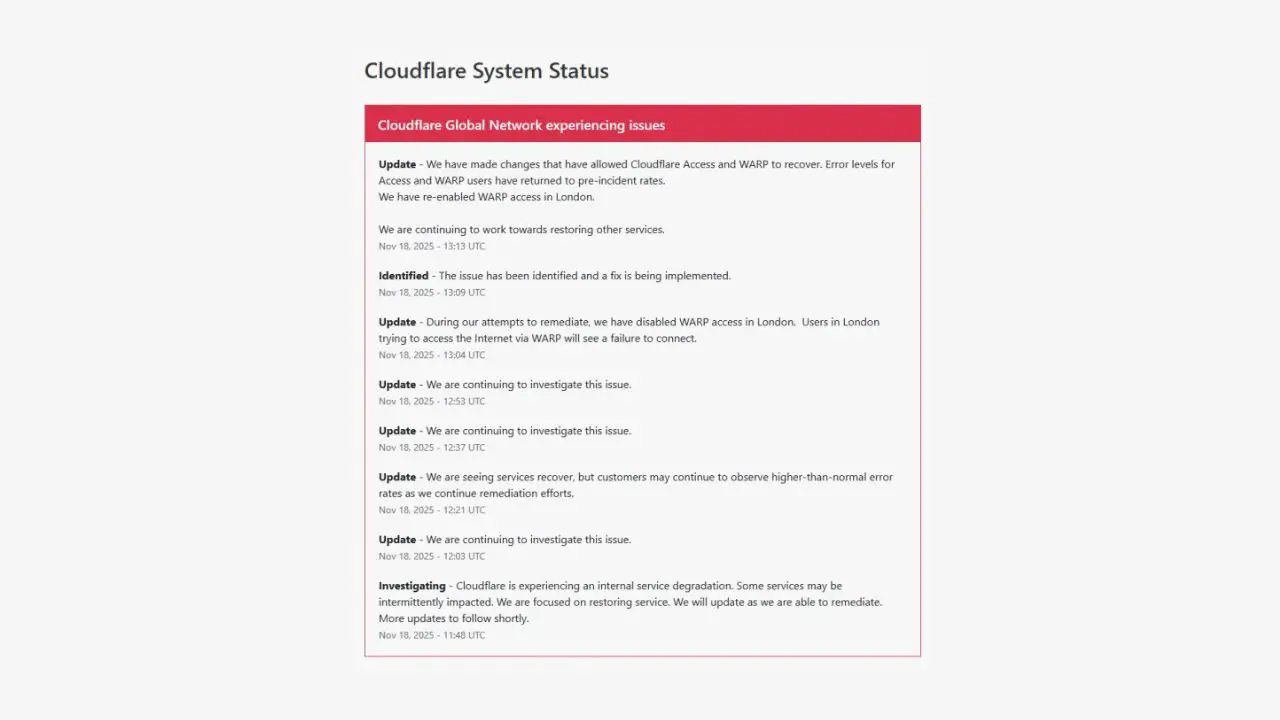
Cloudflare acknowledged the outage on its official status page and stated that its engineers were working to fix the problem as quickly as possible. Users had reported seeing websites load intermittently before going offline again, a sign that the systems were gradually stabilizing but not yet fully restored.
The issue has since been resolved, and services relying on Cloudflare returned to normal after the company implemented the necessary fixes. As always, Cloudflare’s status page provided the most accurate updates throughout the incident.

A reminder of the internet’s fragile backbone
While the internet usually appears seamless, today’s disruption served as a reminder that the technology behind it is incredibly interconnected. When a key infrastructure provider experiences a failure, the effects can spread across the globe within minutes.
Although the outage caused significant inconvenience for users, Cloudflare’s quick response helped restore services and bring much-needed stability back to the internet.