Apple may launch its first touchscreen MacBook Pro in 2026

Akarsh Rasik
4 Min Read
Highlights
  • Apple is reportedly preparing its first touch-enabled MacBook Pro models, bringing touch input to macOS.
  • The upcoming 14-inch and 16-inch models are expected to feature OLED screens and a smaller, hole-punch Dynamic Island.
  • The refreshed interface will adapt to touch gestures while preserving point-and-click navigation.

Apple is reportedly preparing a major change to its Mac lineup with the release of touchscreen MacBook Pro models. According to Bloomberg’s Mark Gurman, the refreshed laptops could arrive later in 2026, following Apple’s early March product announcements.

The upcoming 14-inch and 16-inch MacBook Pro models, internally code-named K114 and K116, are expected to bring touch functionality to macOS for the first time.

OLED displays and a new Dynamic Island design

According to Mark Gurman, the new MacBook Pro models will feature OLED displays, replacing the current mini-LED panels. OLED screens typically deliver deeper blacks, higher contrast, and improved power efficiency.
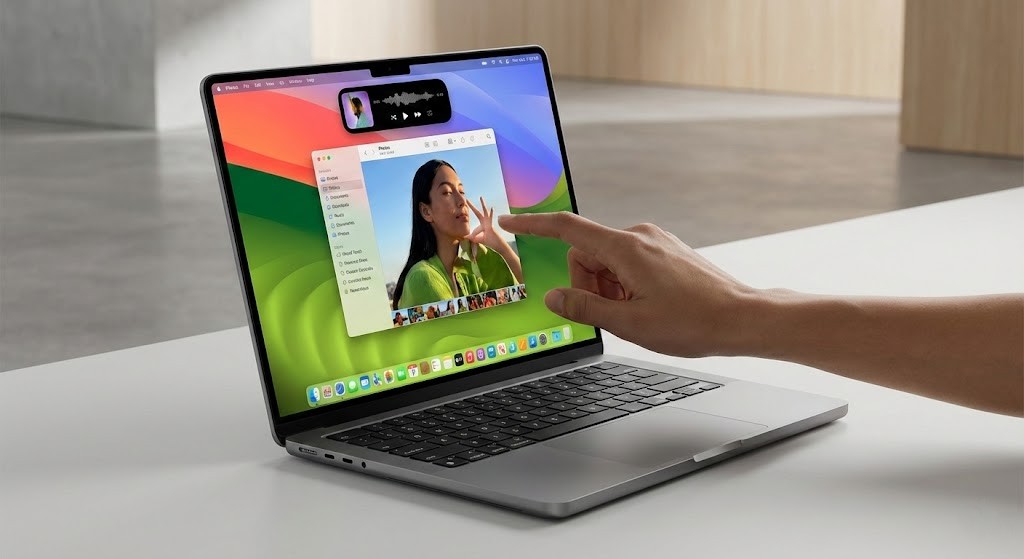
Apple may launch its first touchscreen MacBook Pro in 2026
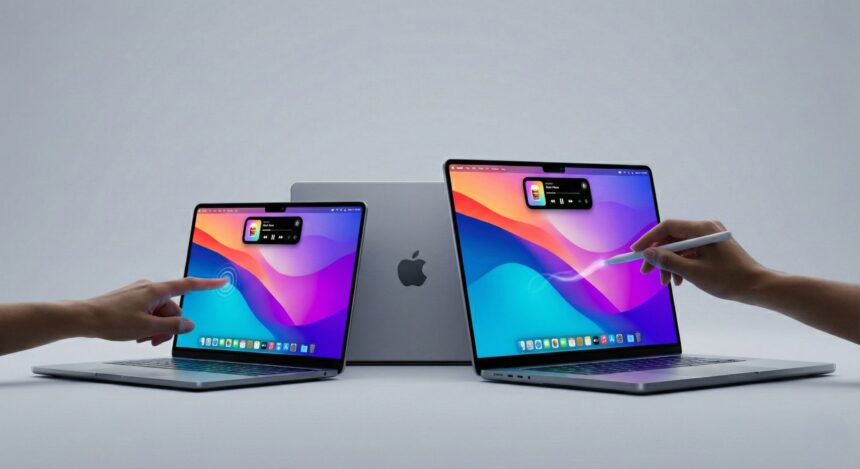
Representational image generated using AI by Akarsh Rasik for TrueTech

Another notable addition is a Dynamic Island element at the top center of the display. Unlike the pill-shaped cutout seen on recent iPhones, the Mac version is expected to use a smaller hole-punch design for the camera.

Dynamic Island debuted on the iPhone in 2022 and displays alerts, media controls, sports scores, and real-time activity updates. On macOS, it could serve similar functions, including showing third-party app updates such as delivery tracking or background task progress.

Designed for both touch and traditional controls

Despite adding touch input, Apple is not expected to ditch the traditional Mac experience. The new models will reportedly retain the full keyboard and large trackpad while adding an interface that adapts intelligently to both touch and pointer-based interaction.

Menus may expand around a user’s finger to improve tap accuracy, while menu bar controls could enlarge when selected via touch. The system is expected to shift smoothly between touch input and trackpad navigation.

Touch-optimized features and gestures

The touch-enabled system is expected to include several usability improvements in order to make interaction more intuitive. Menus, emoji pickers, and common controls may be optimized for finger input, while familiar gestures such as scrolling and pinch-to-zoom should work seamlessly across images, PDFs, and documents.

Users are expected to have the flexibility to use touch as much or as little as they prefer, with the system adapting based on prior interactions and input type. Interface spacing, padding, and slider controls are also likely to be refined, drawing from macOS Tahoe’s “Liquid Glass” redesign to make icons, notifications, and controls easier to interact with using touch.

A notable change in Apple’s philosophy

Apple has historically resisted the idea of touchscreen laptops. Steve Jobs once described them as “ergonomically terrible,” and the company has long chosen the iPad as its primary touch computing device. In 2021, Apple hardware chief John Ternus said Apple already made the “best touch computer” with the iPad and did not see a need to change course.

However, Gurman reports that the touchscreen MacBook Pro will not replace the iPad. Instead, it is expected to offer a hybrid experience that includes touch input with traditional macOS controls.

Part of a broader interface evolution

The reported changes appear to line up with Apple’s broader effort to unify its ecosystem. Gurman also notes that Apple is developing a smaller Dynamic Island design for the future iPhone 18 Pro and iPhone 18 Pro Max.

By bringing touch controls and Dynamic Island features to macOS, Apple may be working toward a more cohesive user experience while preserving the Mac’s core design principles.

Anyway, Apple has not officially confirmed these plans, but the reported changes suggest a careful expansion of how users interact with the Mac.

SOURCES:Bloomberg
Share This Article
Follow:
Writing about emerging gadgets and technology news, as well as keeping you updated on movie and music news, with a focus on all things K-pop.
Highlights
  • Apple is reportedly preparing its first touch-enabled MacBook Pro models, bringing touch input to macOS.
  • The upcoming 14-inch and 16-inch models are expected to feature OLED screens and a smaller, hole-punch Dynamic Island.
  • The refreshed interface will adapt to touch gestures while preserving point-and-click navigation.

Apple is reportedly preparing a major change to its Mac lineup with the release of touchscreen MacBook Pro models. According to Bloomberg’s Mark Gurman, the refreshed laptops could arrive later in 2026, following Apple’s early March product announcements.

The upcoming 14-inch and 16-inch MacBook Pro models, internally code-named K114 and K116, are expected to bring touch functionality to macOS for the first time.

OLED displays and a new Dynamic Island design

According to Mark Gurman, the new MacBook Pro models will feature OLED displays, replacing the current mini-LED panels. OLED screens typically deliver deeper blacks, higher contrast, and improved power efficiency.

Apple may launch its first touchscreen MacBook Pro in 2026
Representational image generated using AI by Akarsh Rasik for TrueTech

Another notable addition is a Dynamic Island element at the top center of the display. Unlike the pill-shaped cutout seen on recent iPhones, the Mac version is expected to use a smaller hole-punch design for the camera.

Dynamic Island debuted on the iPhone in 2022 and displays alerts, media controls, sports scores, and real-time activity updates. On macOS, it could serve similar functions, including showing third-party app updates such as delivery tracking or background task progress.

Designed for both touch and traditional controls

Despite adding touch input, Apple is not expected to ditch the traditional Mac experience. The new models will reportedly retain the full keyboard and large trackpad while adding an interface that adapts intelligently to both touch and pointer-based interaction.

Menus may expand around a user’s finger to improve tap accuracy, while menu bar controls could enlarge when selected via touch. The system is expected to shift smoothly between touch input and trackpad navigation.

Touch-optimized features and gestures

The touch-enabled system is expected to include several usability improvements in order to make interaction more intuitive. Menus, emoji pickers, and common controls may be optimized for finger input, while familiar gestures such as scrolling and pinch-to-zoom should work seamlessly across images, PDFs, and documents.

Users are expected to have the flexibility to use touch as much or as little as they prefer, with the system adapting based on prior interactions and input type. Interface spacing, padding, and slider controls are also likely to be refined, drawing from macOS Tahoe’s “Liquid Glass” redesign to make icons, notifications, and controls easier to interact with using touch.

A notable change in Apple’s philosophy

Apple has historically resisted the idea of touchscreen laptops. Steve Jobs once described them as “ergonomically terrible,” and the company has long chosen the iPad as its primary touch computing device. In 2021, Apple hardware chief John Ternus said Apple already made the “best touch computer” with the iPad and did not see a need to change course.

However, Gurman reports that the touchscreen MacBook Pro will not replace the iPad. Instead, it is expected to offer a hybrid experience that includes touch input with traditional macOS controls.

Part of a broader interface evolution

The reported changes appear to line up with Apple’s broader effort to unify its ecosystem. Gurman also notes that Apple is developing a smaller Dynamic Island design for the future iPhone 18 Pro and iPhone 18 Pro Max.

By bringing touch controls and Dynamic Island features to macOS, Apple may be working toward a more cohesive user experience while preserving the Mac’s core design principles.

Anyway, Apple has not officially confirmed these plans, but the reported changes suggest a careful expansion of how users interact with the Mac.

SOURCES:Bloomberg
Share This Article
Follow:
Writing about emerging gadgets and technology news, as well as keeping you updated on movie and music news, with a focus on all things K-pop.