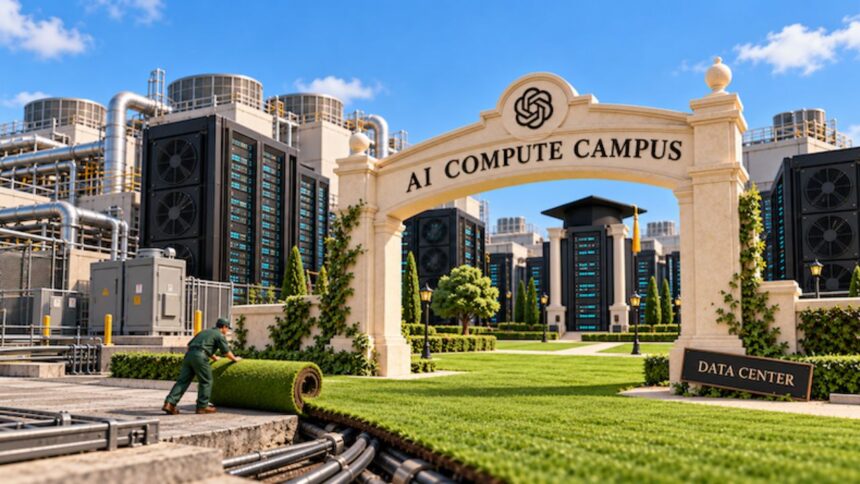
- OpenAI officially rebranded its heavy server infrastructure to compute campuses to sound more modern and community focused.
- Environmental worries grow as a recent Pew poll showed 54 percent of Americans view these facilities negatively.
- Tech companies face political pressure ahead of midterm elections, driving new community investments and branding strategies.
If you’ve ever asked ChatGPT a question, then your answer has been handled inside a huge building full of rows of brightly lit server racks. But these large buildings have had one name for decades, and OpenAI wants to change that to ‘compute campuses.’
The company recently confirmed they will be trying to change the way the entire industry refers to them. Whilst changing just a few words may seem like a small branding exercise, it actually highlights how much of a struggle the AI industry has been having trying to change the perception of their huge and energy-consuming buildings in local communities. But why?
Why OpenAI is pushing to rebrand massive AI data centers into compute campuses
| Feature | Traditional Data Center | OpenAI’s “Compute Campus” |
| Facility Profile | Insular server warehouse focused solely on rack density | Integrated energy and technological hub |
| Resource Impact | Heavy local water draw & steep power grid strain | Framed alongside long-term grid & clean energy investments |
| Community Stance | Frequent NIMBY pushback over noise & resources | Positioned as a local employer & educational partner |
| Primary Narrative | Industrial utility drain | Regional economic & infrastructure catalyst |


The real problem behind the name change
While language is always changing quickly in the tech space, this move comes from a crisis management perspective. Modern artificial intelligence systems require insane amounts of infrastructure.
Sites are using gigawatts of electricity and millions of gallons of water to keep them cool. This has led to people becoming fed up. According to a Pew Research survey, 54% of Americans believe AI data centers are bad for the environment.
This is often difficult to overcome with vague corporate promises, as residents will be concerned about rising electricity costs and water in their area. With mid-term elections making utility grids very much in the news, server facilities have become a hot topic for local voters.
| View on Local AI Data Centers | Percentage |
| Negative Impact | 54% |
| Positive / Neutral / Unsure | 46% |
Can the new name solve grid issues?
OpenAI claims these compute campuses will provide accurate representations of the actual employment opportunities, energy, and academic scale they provide to their host cities. Tech giants such as Meta, Microsoft, and Amazon are also following a similar path by investing in local schools and agreeing to remove their secret non-disclosure agreements with city councils.
However, changing the name doesn’t remove these issues.
- Power Grids: Industrial server facilities put enormous pressure on outdated local power grids.
- Resource Consumption: Liquid cooling systems are receiving significant criticism in drought-affected areas.
- Local Government: Voters and regulators are becoming increasingly concerned about whether tax benefits are worth the cost to their communities.
Overall, whether or not “compute campuses” is a term that becomes popular amongst everyday folk, the core message here for those in the tech industry trying to understand where AI will go next is that it’s going to take real land, real water, and real energy. What do you think about this rebrand? Let me know in the comment section.
Keep up with the tech that actually matters.
Add us as a preferred source on Google Search for quicker access to our coverage.