- Google DeepMind has unveiled WeatherNext 3, its latest AI-powered global weather forecasting model.
- The new model promises more frequent and localized weather forecasts with significantly higher resolution.
- WeatherNext 3 is coming to Google Search, Gemini, Maps and other platforms, bringing its forecasting capabilities to more users.
Extreme weather can change lives within minutes. Considering the same, Google DeepMind and Google Research have upgraded its AI weather forecasting model, calling it WeatherNext 3. The new model is said to provide more frequent, detailed, and localized global weather predictions.
According to Google, WeatherNext 3 brings forecasts every hour and can offer selected surface variables at resolution as fine as 5 kilometers. The newer model is the company’s most advanced and accurate to date and is now being integrated on several Google platforms.
WeatherNext 3 delivers more detailed forecasts
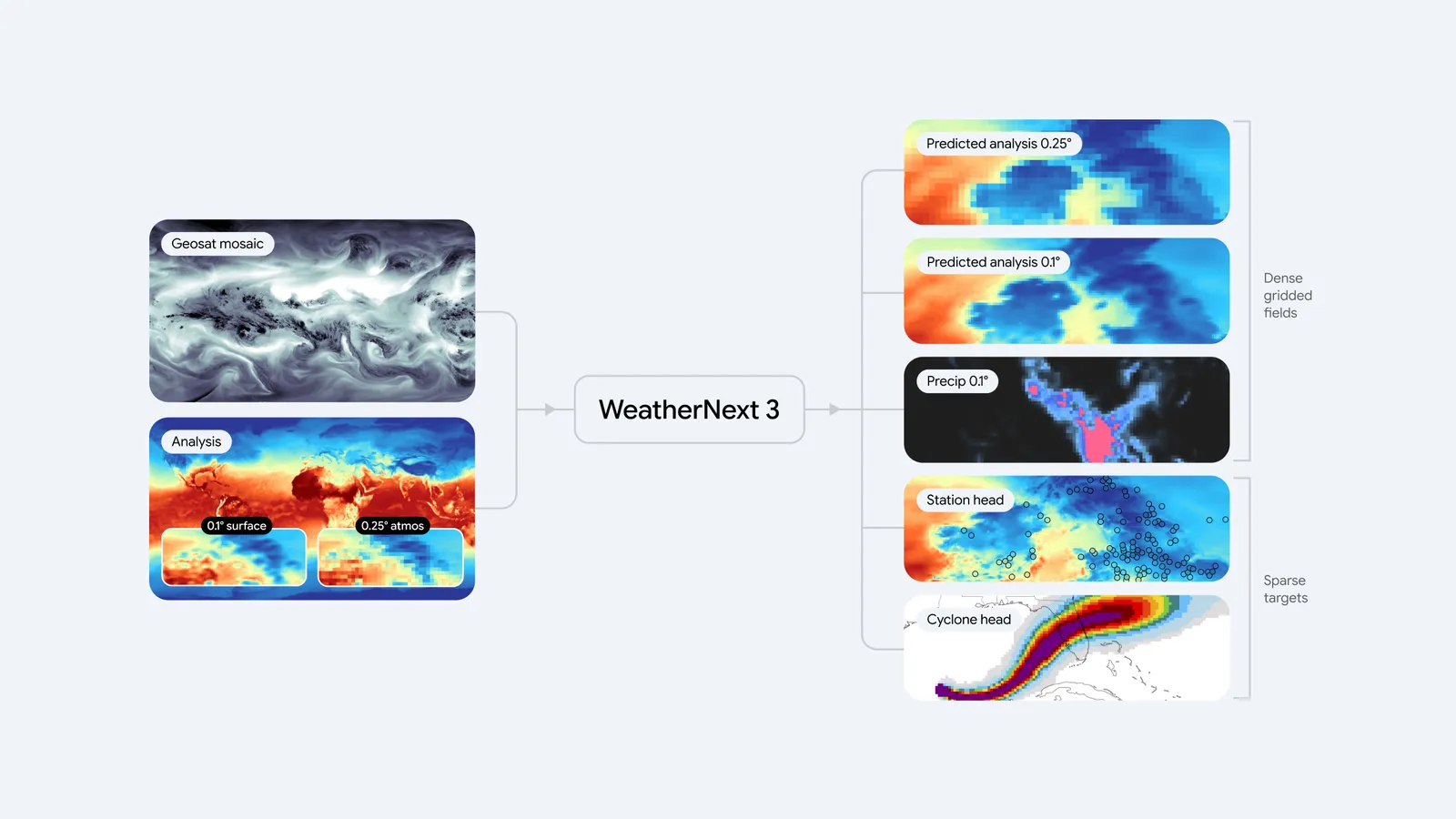
WeatherNext 3 brings forecasts at multiple geographic resolutions while retaining consistency across different levels of the atmosphere.
Google says temperature and moisture can be determined at 5-kilometer resolution, while other surface variables are available at 10 kilometers. Moreover, atmospheric variables, including wind speed, are provided at 25 kilometers.
Model uses real-time satellite and weather station data
To maintain the accuracy and consistency, Google has changed the data to develop the newer model.
Its predecessor, WeatherNext 2, was trained using data from numerical weather prediction (NWP) models. While the upgraded model learns directly from observations, along with a geostationary satellite date and weather station observations.
Every hour observation is not something you won’t understand. In simple words, the satellite data brings an updated view of atmospheric conditions, which enables the model to generate a new forecast every hour using more recent observations. Furthermore, training directly on weather station observations also helps the newer model gather regional characteristics such as topography.
WeatherNext 3 focuses on precipitation forecasting
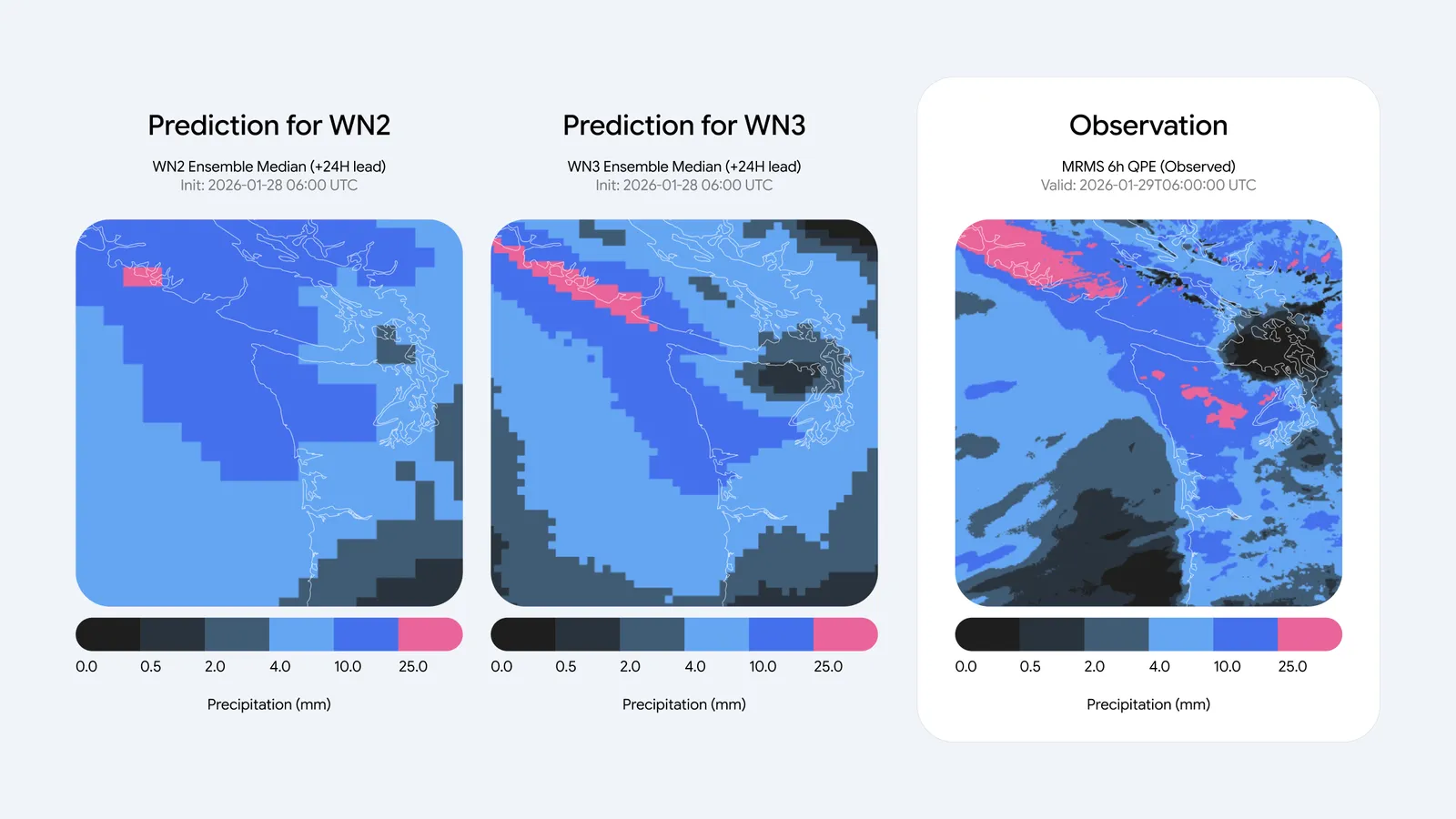
For global weather forecasting, precipitation is one of the most challenging aspects, because any uncertain rain and snow can develop through fast-changing processes at relatively small scales.
As per Google, WeatherNext 3 was trained using data from NASA’s Integrated Multi-satellite Retrievals for GPM (IMERG) and Google’s global precipitation reanalysis with respect to satellite radar to improve precipitation predictions.
The company reports that the new model was able to show improvements in Continuous Ranked Probability Score (CRPS) of up to 60% against IMERG, 30% against MRMS, and 10% against rain-gauge measurements in its lab testing.

New forecasting features for renewable energy
Along with the aforementioned usage, WeatherNext 3 also integrates forecasts intended for renewable energy applications.
As a result, the model is designed to predict 100-meter wind speeds, according to Google. It is approximately corresponding to the height relevant to wind turbines. In addition, it also offers high-resolution cloud-cover and solar-radiation forecasts.
Such data is designed to help renewable-energy developers and grid operators predict wind and solar power production and better plan electricity supply against demand.
Google says forecasts can be more accurate a day ahead
For forecasts made a day or more in advance, Google’s new weather forecast model will improve longer-range weather forecasts as well as short-term predictions. Google reports up to 50% greater precipitation accuracy.
WeatherNext 3 comes to Google products and developer platforms
Google is expanding its WeatherNext 3 across its ecosystem. Consequently, the newly announced model will power weather experiences in Google Search, Gemini app, Google Maps, Google Earth Engine, and Google Maps Platform Weather API.
On the other hand, the company is making the forecast data available to researchers, developers, and businesses. Users can query the data through BigQuery and Earth Engine, while bulk datasets can be accessed via Google Cloud Storage.
Keep up with the tech that actually matters.
Add us as a preferred source on Google Search for quicker access to our coverage.