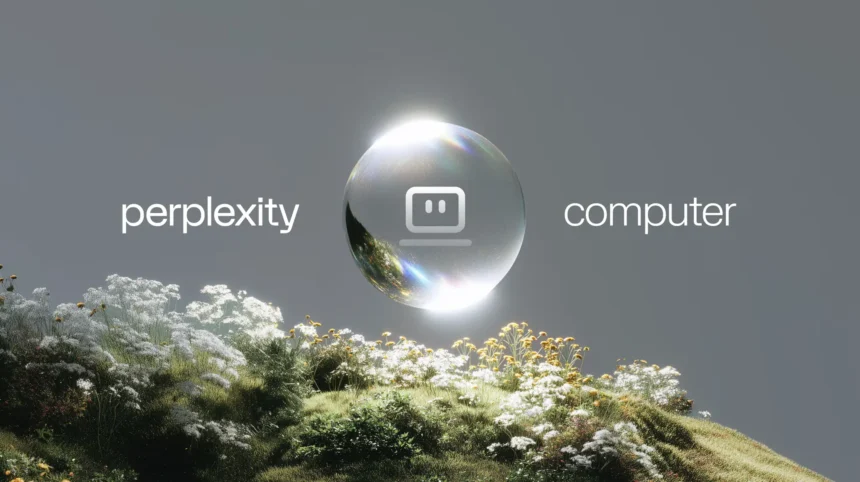
- Perplexity Computer goes beyond chat responses and single-task agents by executing complete workflows.
- The platform routes tasks across up to 19 AI models, including Claude, Gemini, ChatGPT, Grok, and DeepMind Veo.
- The system uses sub-agents to perform tasks in parallel, resolve issues autonomously, and scale from single tasks to hundreds of simultaneous projects.
Perplexity has launched Perplexity Computer, a new platform that brings multiple AI capabilities together in one place so users can research, design, code, deploy, and manage projects from start to finish.
Unlike standard chat interfaces that simply generate answers, or task-based agents that perform single actions, Perplexity Computer is configured to execute complete workflows. Once a user defines a desired outcome, the platform breaks the goal into structured tasks and subtasks, assigns them to specialized sub-agents, and runs them simultaneously.
Designed for end-to-end workflow execution
Perplexity Computer can operate for long durations and supports asynchronous workflows. Users can run multiple instances at the same time, which allows them to scale from a single task to hundreds of active projects.
Sub-agents within the platform can perform a range of functions, including:
- Conducting web research
- Drafting and editing documents
- Processing and analyzing data
- Making API calls to connected services
- Writing, testing, and deploying code
If the system encounters an issue, it can create additional sub-agents to resolve the problem. This may involve researching missing information, locating API credentials, building required components, or requesting clarification from the user only when necessary.
Each task runs inside an isolated compute environment that mimics a real digital workspace. These environments include a functional filesystem, a browser, and access to integrated tools and external APIs. Anyway, the platform is accessible through the web and does not require local installation.
Model-agnostic framework routes tasks to the best AI
Perplexity Computer uses a model-agnostic orchestration framework that assigns each subtask to the AI model best suited to handle it.
At launch, supported models include:
- Anthropic Claude Opus 4.6 for reasoning and task matching
- Google Gemini for deep research and sub-agent creation
- OpenAI ChatGPT 5.2 for long-context recall and broad search
- xAI Grok for fast, lightweight tasks
- Google DeepMind Veo 3.1 for video generation
- Nano Banana for image generation
Overall, the platform can route work across 19 models. Users can manually choose models for specific subtasks and apply spending limits to manage token usage. Because the architecture is model-agnostic, models can be updated as newer versions become available.

Infrastructure and built-in connectivity
Perplexity Computer runs on Perplexity’s infrastructure and includes hundreds of service connectors, persistent memory to retain prior work, file handling capabilities, and web access. The system maintains context across projects while applying default security controls.
Pricing and availability
Perplexity Computer is available via the web for Max subscribers under a usage-based pricing model.
Max subscribers receive:
- 10,000 credits per month included with the subscription
- A one-time bonus of 20,000 credits
- Launch bonuses for existing users and signup bonuses for new users
- Bonus credits that expire 30 days after issuance
Users can manage costs through model selection and spending caps. Perplexity indicated that support for Pro and Enterprise plans is expected in the near future.